Tuesday, February 15, 2011

Rock Art: A Tribute to Hovenweep's Beauty and Ranger Chris Nickel

Hovenweep National Monument is an exquisite land of rock, sculpted by nature for millions of years, altered by ancestral Puebloan people for centuries, and both protected and made accessible to the American people and our guests by presidential proclamation in 1923. It is also a place of beauty, mystery, fascination, and inspiration. Rock art, in its many and varied forms, is abundant here.

When we think of rock art, we most commonly think of the intricate, evocative, and mysterious ancestral Puebloan petroglyphs and pictographs.  There are several fine examples of each type at Hovenweep.

At the Cajon unit of the National Monument, there is a panel of pictographs, paintings on the rocks, in an alcove beneath the canyon rim.

Pictographs at Cajon

It is hard to know the significance of any of the rock art here. It is widely accepted though, that rock art is not graffiti. Rock art is more likely a record of travels or migrations, a marking of territory and special features such as springs or ceremonial sites, or used to track the passage of days, seasons, and celestial events. The three most visible pictographs at Cajon are of a deer, a very typical pottery type design, and what may be a scorpion or centipede. The deer may represent a clan of residents. The pottery design could be simply that, a sketch of the decoration commonly used by those people. The scorpion or centipede may represent crawling animals or clans. That pictograph could also represent a ladder made of a single pole with log rungs. Regardless, the Cajon pictographs are fascinating and hold a beauty and mystery of their own.

Close-Up of Cajon Rock Art

At Hovenweep’s Horseshoe site, there is a fine collection of handprint pictographs that are well protected by an overhanging cliff upon which stands Horseshoe House. The handprints at Horseshoe are considered “positive” images, made by applying paint to the hands and then making prints on the canyon wall.

Handprints at Horseshoe

Handprints may simply be a record of who was there, a family or kinship group gallery, or a message to descendents.

At both the Hackberry and Square Tower units of Hovenweep, handprints can be found that were made in a different fashion creating “negative” images. Paint was sprayed over a hand resting on the rock wall, leaving an outlined painting and empty space where the hand was.

Handprint at Hackberry

Little Ruin Canyon Handprint

Petroglyphs are found in two locations at Hovenweep. Petroglyphs are etchings in the rock, often on sections of rock that have been stained with “desert varnish” which is made of clay and oxidized minerals (primarily iron and manganese), processed by microorganisms.

Desert Varnish

At the Square Tower section of Hovenweep, the petroglyph panel is directly below the round tower structure at Tower Point. Found there are a snake, a lizard, three images of macaws, a T-shaped doorway, an open spiral, and a geometric symbol. The open spiral is often thought to be a symbol of migration, and is consistent with the oral histories of present day Zuni and Hopi peoples who tell stories of their ancestors’ migrations leading to their present-day locations.

Petroglyph Panel in Little Ruin Canyon

The petroglyphs at the Holly Unit of Hovenweep are particularly unique. They are etched into a wall beneath an overhang of a broken boulder on the canyon slope. There are three sun symbols made up of numerous spirals and concentric circles. At sunrise on and around the summer solstice a dagger of light shines through a narrow gap formed by the upper edges of two additional boulders and passes through the petroglyphs, and at its most intense, connects the centers of the spiral and concentric circles which are several feet apart. The Holly Solstice Panel is one of several calendrical features found at Hovenweep.

Summer Solstice Petroglyphs at Holly

I am convinced that Hovenweep’s ancestral Puebloan structures should be considered rock art as well as the pictographs and petroglyphs.  Exceptional craftsmanship is clearly demonstrated in the shaping of both rock and structures. When one looks closely at the rockwork in any of the towers or other buildings at Hovenweep it is easy to see the way the sandstone rocks have been pecked and shaped, in many cases looking more like fabricated bricks than native stones.

Masonry Detail at Cutthroat Castle

Many of the building blocks used in structures like Hovenweep Castle are so brick-like in shape that beautiful square corners are created. The rockwork and masonry in these 800 year old buildings indicate a level of skill that is far from primative.

Hovenweep Castle from Little Ruin Canyon Bottom

One of the towers at the Holy unit of Hovenweep National Monument is square however the corners themselves are rounded. Again, the evidence that the rock was carefully worked is clear and the very detailed and exact nature of the ancestral Puebloans’ construction techniques are apparent. Round, square, or some other shape, the towers of Hovenweep are testament to the expertise of their builders.

Masonry Detail at Holly (Rounded Square Corner)

The vast majority of the remaining Hovenweep structures are built on canyon rims, on the solid foundation that bedrock provides. Several of the towers are built on boulders which stand on the canyon bottoms or on talus slopes. Perhaps most unique is a round tower at the Cajon site, built on, around, and fully incorporating three boulders on the canyon floor. Such construction, to me, indicates an intimate knowledge of the land, the rocks, and very sophisticated building techniques.

Round Tower Incorporating Boulders at Cajon

One building that makes almost whimsical use of a boulder on a canyon slope is Eroded Boulder House in Little Ruin Canyon. It seems clear that the ancestral Puebloans had an architectural aesthetic. The towers and other structures of Hovenweep are, indeed, another form of rock art.

Eroded boulder House, Little Ruin Canyon

Yet one more set of changes to the land created by the ancestral Puebloans at Hovenweep holds beauty and intrigue for me. When first created, they were purely functional. With the centuries, they have, for me, taken on the quality of art. At the Horseshoe site, there is a "Moqui Step" carved into the rock, a simple aid to make climbing out of the canyon easier.
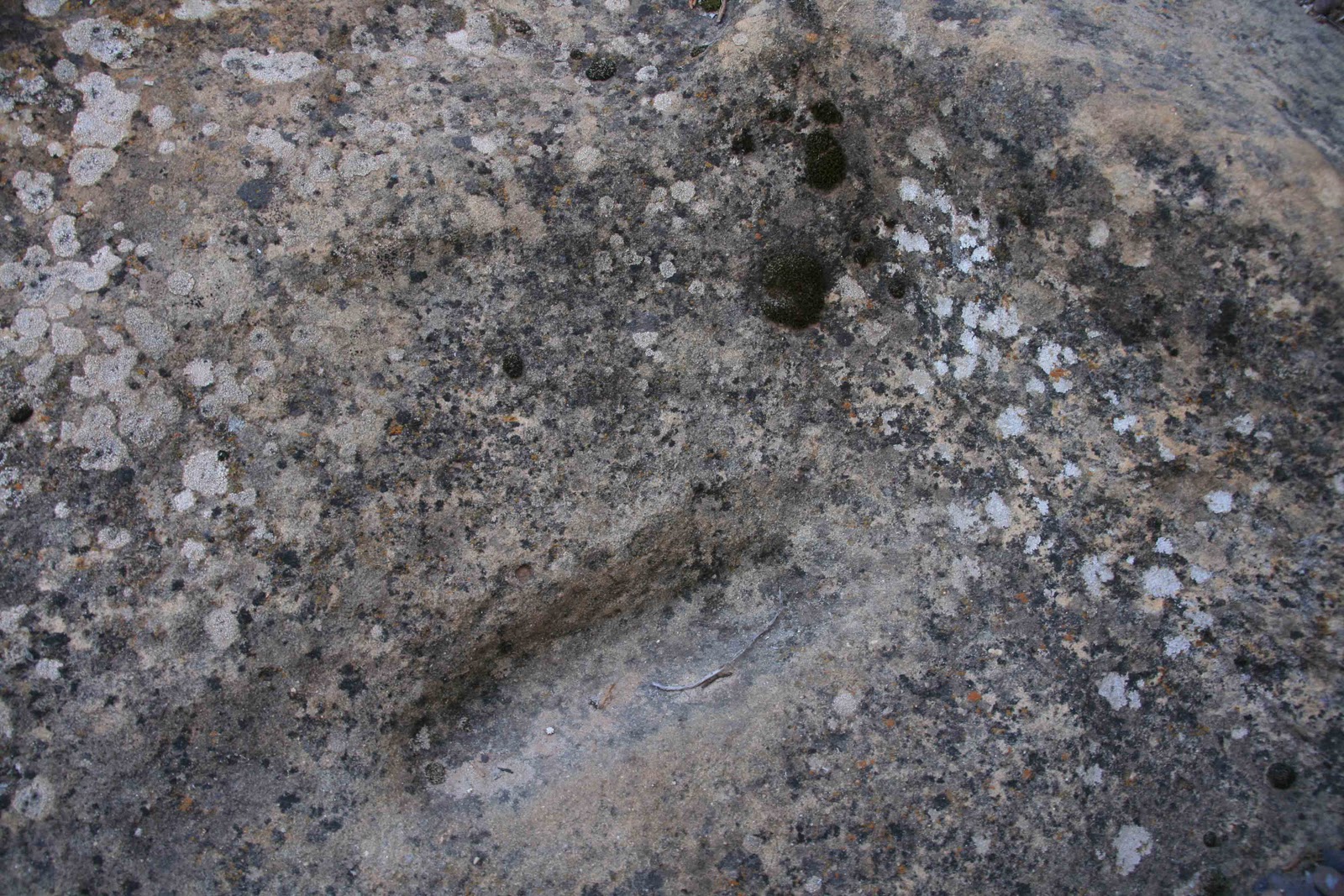
Moqui Step at Horseshoe

At both Little Ruin Canyon and Cajon, there are depressions in the rock used for grinding corn and other seeds as well as for sharpening tools. These carvings in the bedrock, like art pieces, reveal something of their creators.

Grinding Depressions at Cajon

In my nearly three months at Hovenweep I have found great beauty in the rocks. Like the "rock art" left by the ancestral Puebloan people, there is also Nature's geologic "art." The upper layer of Dakota Sandstone creates a gently undulating surface. In its potholes and curves it is easy to visualize its origin, being deposited on the bottom of a shallow sea.

Potholes in Dakota Sandstone

Dakota Sandstone

Beneath the surface layer of sandstone is the only other rock formation at Hovenweep, the Burro Canyon Formation. This is primarily a conglomerate rock, laid down as river bottom sediment.  In seeing the variety of pebbles cemented together in discernible layers it is easy to visualize that rocky Cretaceous river.

Burro Canyon Conglomerate, Little Ruin Canyon

Burro Canyon Conglomerate at Cutthroat

At the point immediately beneath the sandstone there are some deposits of shale which were laid down in muddy deposits as the river filled and became a marshy environment.

Burro Canyon Shale at Horseshoe

In one of my last days at Hovenweep I noticed a small rock arch, formed as the porous and layered sandstone eroded due to repeated freezing, thawing, and other action by water and wind. Though the void beneath the arch is only about six inches high and the span is less than three feet, it is another example of the beauty found in this exquisite land of rock.

Miniature Arch at Horseshoe

We mark the trails here at Hovenweep with either cairns (piles of rocks) or rock borders. This is critical for visitor wayfinding and for resource protection. In particular, we work heard to protect the unique cryptobiotoc soil crust which is particularly robust at Hovenweep. The biological soil crust or "hidden life" is a symbiotic relationship between fungi, moss, lichens, cyanobacteria, and the mineral soil itself. The knobby black to brown crust slows erosion, makes nitrogen and carbon available for plants, and helps to retain precious moisture. It also grows very, very slowly. One misplaced footstep can undo decades worth of biological work. We are vigilant about keeping visitors on the trail so as to protect the cryptobiotic soil crust as well as the other natural and cultural resources preserved at Hovenweep.

Trail Border Protecting Soil Crust


In some places the rock borders have an artistic and aesthetic appeal all their own.

Rock Border and Trail at Horseshoe/Hackberry

On Saturday January 29th, I was working with my fellow volunteer, Petra, and our Resource and Visitor Protection Ranger, Chris Nickel. That morning we laughed about the trail borders which Chris was referring to as “our rock art.” He planned to be on the trail that afternoon for the first time in the two months I had been at Hovenweep. For eighteen months Chris had been in the position of "Acting Chief Ranger" for both Hovenweep and Natural Bridges National Monuments and it was earlier that week that the position was finally filled and the new Chief Ranger had reported for duty. Chris shared his joy in returning to his single, dedicated position at Hovenweep and celebrated that he could, once again, perform his duties to his standard. One thing Chris intended to do while on the Little Ruin Canyon Trail that day was to check the effectiveness and aesthetics of our "rock art." In anticipation of his patrol, he produced some before and after photographs from previous seasons in the park. It was very clear that he was using the term "before" to mean "bad" or ineffective and the term "after" to mean "Chris's way." Out of respect for Chris and in celebrating his joy in getting into the field, we did not question his expectations of the trail marker conditions. We did hope that our work met his standard of perfection. 

The Way "Rock Art" Should Be!

Chris set the tone that has made Hovenweep such a positive and pleasant place to work. Early in my time here Chris sat down with me so he could share his “perspective on the park.” He made it clear that the most important aspect of our work here was the protection of the many and unique natural and cultural resources. He also emphasized the importance of providing the highest quality visitor experience and that the only thing that might limit the activities of our visitors would be our vigilant protection of the park itself. Hovenweep, as a very small unit of the National Park System, works. It is a positive, affirming, stimulating, beautiful, and challenging place. I say this in thanks to Chris, to our Lead Interpreter Todd Overbye, and to our Maintenance Supervisor Alan Shumway. Together, these three men oversee a small team that has been an amazing joy to be part of.

It is with great sadness that I report Chris Nickel's passing. On that beautiful, almost balmy Saturday afternoon, Chris left the Visitor Center to get a bite to eat at his residence and then head onto the trail to oversee his special domain. Early on his hike, Chris collapsed and died. We don't know what happened but believe that he did nothing more than sit down and die. HIs death has left a huge hole in the Hovenweep community and our collective heart. The only sense of consolation or peace in this tragic incident is that Chris passed while overseeing a place he loved and cared deeply for. It is in tribute to him, his work ethic, his solid commitment to resource protection, and his special way in the world that our park community has been rededicated to carrying on and holding close to the lessons he provided.

My dear friend, colleague, and fellow volunteer Petra is better and more economical with words than I am. Her tribute to Chris cut right to the heart of who he was and the impact he has had.


The Provenance of Stars


R.I.P. Chris Nickel: friend, colleague.


Your kind, dryly witty, meticulous, nature-loving, pistol-packing      soul will forever walk the trails at Hovenweep National Monument.

The smell of sage will always remind me of you now; and I will always be convinced that shooting star I saw was you, laughing.

From the pleasure of working for and with Chris, and out of the saddness of losing him, I can only say, "thanks!" My work will always, to some degree, be guided by him.

In Honor and Memory of Ranger Chris Nickel

Friday, January 7, 2011

Enchantment and Illumination in Our National Parks

Sunset from Chapin Mesa, Mesa Verde National Park


On December 9, 2010, I had the wonderful opportunity to visit Mesa Verde National Park on the night of their annual Luminaria Holiday Open House. It was a wonderful evening in which I was able see a remarkable sunset, tour the Chapin Mesa Archeological Museum, enjoy a bowl of white chili that I still think about, listen to local musicians including a wonderful Navajo flute player, and tour Spruce Tree House by candle light. Even though there were hundreds of visitors in the park that evening, I felt comfortably alone, able to take in the sights and the site on my own terms. 

Luminaria on the Trail to Spruce Tree House


Viewing the candle lit Spruce Tree House from the canyon rim I was able to transport myself back about 750 years and imagine what it might have been like returning “home” on a winter’s night after a hunting or gathering expedition.

 
Spruce Tree House


The walk into the canyon, past the seep spring that surely supplied the people there, and to the cliff dwellings had the same feel as approaching my own house at night, illuminated by a simple light bulb or two, welcoming me in, assuring me of the comfort waiting there. It was a very special and enchanting night, choreographed very well by the park staff and volunteers.

The notion of hearth and home is strong and, I believe, has likely remained consistent through the centuries. 

Close-Up of Spruce Tree House

The night of luminaria at Mesa Verde reminded me of a similarly enchanting and illuminating experience I had at another national park about a decade before.

While working in the Washington Office of the National Park Service, Warren and I and two friends traveled to Antietam National Battlefield for the park's annual Memorial Illumination. Not knowing fully what to expect but anticipating a night-time, candle-lit drive through the protected countryside, we arrived at the park for what proved to be an enchanting and powerful experience. We had read that there would be a candle in honor of each casualty of the battle at Antietam, and having previously visited the park understood that we would be at the site of the deadliest day in American history. It was on that rolling Maryland landscape on September 17, 1862 that some 23,000 people were killed, wounded, or missing after twelve hours of fighting.

We approached the park entrance a bit after dark on a very cold December night and were greeted by a park volunteer directing us to the road we were to drive on. He asked us to turn off the car’s headlights so as not to overwhelm the experience of others. Our candlelight journey began in a pastoral fashion and seemed sanguine enough. The park road was bordered with glowing luminaria, one on each side of the country lane, every ten yards or so. The display continued in this fashion for half of a mile, perhaps, as we drove toward the top of one of the area’s beautiful rolling hills. As we crested the rise, we were not prepared for the scene before us. The field we were about to drive through was literally covered with candles for as far as we could see. It was an overwhelming sight.

We had visited Antietam before and had learned the story of the battle from the park film, narrated by James Earl Jones, and from viewing exhibits and attending interpretive talks. All of those experiences had been interesting, educational, and moving in their own rights. We knew that Antietam was the culmination of the Maryland Campaign of 1862 by the Army of Northern Virginia, the Confederates, their first foray into the North during the American Civil War. We also knew that the battle at Antietam was the catalyst President Abraham Lincoln needed to finally acknowledge and confirm that the war was more than a regional uprising but was a conflict with the idea and institution of slavery at the very core. A mere ten days after the battle at Antietam, Lincoln issued the preliminary version of the famed Emancipation Proclamation, forever freeing slaves in the Confederate States. Our previous experiences and knowledge were driven into our hearts by the scene before us.

Lincoln at Antietam (Library of Congress)


On that December night, each of the thousands of candles represented a life and a person in struggle. For us, they illustrated the magnitude of carnage and tragedy experienced that day and throughout the days leading to and including the American Civil War. The candles also shone for the additional thousands of Americans in captivity who were soon to be free. On one hand, the luminaria evoked pain and that final recognition of the horrors and realities of war. On the other, they evoked hope. Each light stood in for a person fighting for a cause they believed in or were taught to believe in. They honored those who fell there. The candles also stood in as painful reminders that the struggle for freedom is long and circuitous. I was reminded that the struggle continues. To me, this seems particularly important as we approach the sesquicentennial observance of the American Civil War in challenging political times. We each need to hold close that magical and overwhelming light as we continue to struggle against the selfishness and small-mindedness that allows our society to practice discrimination and oppression in any form. The enchantment can serve to fuel the light within.

I have shared in other enchanting experiences while visiting national park sites such as those I had at Eisenhower National Historic Site in Gettysburg Pennsylvania. During my Washington, DC days I spent a lot of time in Gettysburg, not due to any significant interest in military history or strategy, rather a compelling interest in the process of commemoration and the creation and evolution of iconic landscapes. I found myself particularly interested in the stories told at Gettysburg and the differences between the public presentations by the National Park Service and private presentations such as battle reenactments, and programs offered  at the American Civil War Wax Museum and the Gettysburg Tour Center. Whenever time exploring the battlefield and the tragedy of war became overwhelming or the sights I was seeing a bit too bizarre (one of my favorites was seeing Confederate and Union soldiers dining together at an outdoor cafe), I would head to Eisenhower. The Eisenhower Farm, the only home ever owned by President Dwight Eisenhower and Mrs. Mamie Eisenhower, was a lovely respite from the carnage of war, the fascination many have with it, and the pain that seems embedded in that contested land. It is a home they bought in 1950 and after significant renovations began to use the house and adjoining farm as their weekend retreat during the Eisenhower presidency. It became their full-time home when Eisenhower left office in 1961.


Eisenhower Lawn Chairs (NPS Museum Management Program)

I have enjoyed the Eisenhower site on numerous visits. On my first visit there, I was able to become a Junior Secret Service Agent (the park's version of the Junior Ranger Program). I had also enjoyed park rangers presenting captivating living history programs, including Secret Service Agents, members of the press lurking on the grounds hoping to see the President and First Lady or the many world leaders they entertained. I even got to meet the First Lady herself on one visit. I was fascinated to hear her thoughts on fashion, home decorating, politics, and even the Paint By Number craze that swept the nation with the President's tacit blessing and encouragement. Each visit made me excited about the next one and the unique and fun experiences awaiting me.

With that excitement, Warren and I made the trip to Gettysburg to visit the Eisenhower site during the Christmas celebration in which the house was to be decked out as it was in the 1950s and early 1960s, with the family holiday decorations. We rode the tour bus from the Gettysburg Visitor Center and were greeted at the Eisenhower Farm by a park ranger who gave us a brief orientation to the site and then told us that we had a very special treat in store for us that day. He announced that our tour guide in the house would be Mrs. Eisenhower's personal physician. Having enjoyed other captivating living history presentations at the park, we were drawn right in and very excited. We were ready for another compelling performance by a park ranger portraying the physician. Our group was directed to the front door of the farmhouse and when the door opened, we were welcomed in by an elderly man with an official name tag with the acronym "M.D." appended to his name. As it turned out, he REALLY WAS Mrs. Eisenhower's doctor. Dr. William North Sterrett had been the Eisenhower's local physician and upon his retirement he became a park volunteer, guiding tours of the historic site on Fridays. It was our great luck that we visited the Eisenhower home on one of Dr. Sterrett's days.

While we were guided through the lover level of the Eisenhower house, we listened intently to Dr. Sterrett's description of the house, the objects in the formal rooms, many of which were gifts from international dignitaries. It was when we went upstairs to the living quarters that we were fully in the Doctor's spell. Among the recollections he shared about the President and First Lady he described the day in September of 1979 when he came into the house and found Mrs. Eisenhower in her bed, having suffered a serious stroke. He described how the President's side of the bed was covered with books, placed there by the First Lady to ward off loneliness. He relayed the anguish he felt in sending her to Walter Reed Army Hospital in the Washington, DC area, the same place the President had died ten years earlier. Mamie Eisenhower would not return to the Gettysburg home, passing away at Walter Reed just more than a month later. Being so fortunate to participate in Dr. Sterrett's very special tour, we were certain that the Eisenhower National Historic Site was enchanted, indeed. We got to see the wonderful 1950s holiday decorations AND the family doctor.


Eisenhower Bedroom (Retro Renovation)

 As if that holiday visit was not enough, on another park ranger-guided tour of the Eisenhower home, again while looking at the Eisenhower bedroom, a diminutive older woman in the group stepped forward to the rope keeping us from entering the room and announced to the ranger that she had been on Mrs. Eisenhower's household staff. Rather than feeling interrupted, the ranger immediately asked a few questions of the woman, encouraging her to share recollections she was comfortable passing on the the entire group. She was describing the way Mrs. Eisenhower was quite particular about some things in the bedroom and her adjoining bathroom. So, the ranger invited the former domestic worker into the room to view the the First Lady's bathroom which was mostly out of view of the tour route. While the two of them were beyond our sight lines, we all privately marveled at our good fortune to experience such a special reminiscence. When the ranger and the woman returned to the group, the ranger shared some of the memories she had recalled of her time working in the Eisenhower home and for Mrs. Eisenhower. By allowing the elderly woman to have her special time in the home she knew intimately and to then guide the rest of us, the ranger made her day, and ours.


Mrs. Eisenhower's Bathroom (Retro Renovation)

AND THEN, a man on the tour shared that he had been a Secret Service Agent stationed for a time at the Eisenhower farm. She shared some recollections of his work there, and of his interaction with the Eisenhower grandchildren. Enchanted? Again, yes!

So, where am I going? I have been thinking a lot lately about the very special experiences I have had in national parks and what effect that can have on the work I do, essentially facilitating experiences for park visitors. By no stroke of imagination do I equate my work with the wonderful park experiences I have described here. I do, however, want to hold my recollections of such enchanting and illuminating times close to remind me of the possibilities park experiences may present.

Here at Hovenweep National Monument, we have a wonderful commitment to providing a positive, somewhat understated visitor experience while being very clear about protecting the cultural and natural resources. We know that visitors to Hovenweep value the remote character of the park and the sense of discovery they can have in this special place. The recent Long-Range Interpretive Plan for the park identifies the following as the first of several guiding principles: "Do not over interpret the site and its resources. Allow the visitor to experience and discover certain aspects of the monument themselves." Our approach is to not overwhelm the visitor with any overwrought interpretive finesse.

I spend roughly half of each day on the trails at the Square Tower unit of the park and the outliers, when they are accessible. The goal of the roving duty is twofold: to make sure the park resources are not compromised in any way (which most frequently has me erasing footprints from people who strayed from the marked trails), and to make myself available to the visitors and to offer them any information, answers, or interpretive guidance they need. We typically recommend that folks hike the Little Ruin Canyon Trail a specific direction, which has them descending the north side and ascending the south of the canyon at the beginning of their two mile hike when they are fresh and energetic rather than saving that more strenuous part of the walk for later. The remainder of the trail circles the canyon rim. I, then, typically travel in the opposite direction, thus affording opportunities for contacting the visitors.

During the last couple of weeks, while roving the Little Ruin Canyon, I have had several opportunities to lead small groups of visitors into an area that they can not go unless accompanied by a park ranger or volunteer as their guide. Beneath Tower Point, where the two side canyons come together to form the main stem of Little Ruin Canyon, there is a very intriguing collection of petroglyphs and some other rock art. The trail into the canyon and to the petroglyphs had previously been part of the self-guided experience but visitor safety and protection of park resources caused that section of trail to be closed without a guide. The trail traverses a very uneven surface, at times requiring one to scramble around, over, and between boulders and the edge of the canyon. Along one section, a small ancestral Pueblo structure is found beneath a rock overhang. In the past, visitors found that to be a very nice place to stop for a picnic. The structure was damaged by heavy use and food scraps left behind attracted packrats whose collecting of food and burrowing has caused additional damage to the site. In the summer, daily walks to view the petroglyphs are scheduled. During the winter, walks are not scheduled but done only as needed or conditions allow.


Petroglyph "Trail Closed" Sign


On the day that I guided my first petroglyph hike, I was roving the area and two pairs of visitors arrived near the the trailhead at the same time. We spoke briefly, allowing me to answer some questions from the visitors. As the questions ceased, I realized I had a special opportunity and asked if they would like to take a bit of an adventure to a place not open on a general basis. All four seemed both intrigued and willing. I described the type of terrain we would be covering and made sure that they were all prepared for some ups and downs and an uneven surface. As we descended below the canyon rim and along the narrow trail, everyone was quiet. I think there was some initial reserve and uncertainty. That somewhat awkward silence was broken when one of the women discovered a granary high on the opposite canyon wall. Her excitement infused the others with intrigue and a heightened awareness to what they might find along this special hike. I was elated by her discovery and the way that guided our collective experience. We immediately became a group of five co-leaders on our little expedition. This made my job easy, though I had to exercise a healthy level of restraint, allowing the discoveries to belong to the group, not me.


Granary On Canyon Wall


The discovery of the granary inspired a number of questions from the small group. The ensuing discussion allowed us to speculate on the lives of the ancestral Puebloans and the challenges they faced on a daily and seasonal basis. Simply getting corn and other grains to the granary for storage was a significant task, not to mention the agricultural knowledge and understanding of this dryland environment that was necessary to feed the community. As we continued along the canyon wall, one of the men who identified himself as an entomologist found some galls on rabbitbrush created by a small fly and antlion pits in the sand beneath an overhanging wall. He brought these insect-made structures to the attention of the group and shared his knowledge with the rest of us.


Antlion Pits

A bit farther along the trail I paused, stooped down to look at a low overhang and asked the members of the group to see if they could find anything. My four guests looked intently but did not seem to notice anything unusual or special until one of the women shrieked with joy. On the ceiling of the small overhang was the painted outline of a single hand.


Handprint

The handprint is the only pictograph along the special trail. The visitors were fascinated by it, holding their hands up near the wall to compare size. They wondered if it was made by a lone child, or by an adult. This provided us an opportunity to discuss what archeological evidence indicates about the small stature of the ancestral Pueblo people. They also wondered about the significance of a handprint. Might it say, "I was here?" Or, "This is my place." We discussed the potential method of painting this handprint with paint surrounding the hand rather than paint being applied to the palm of the hand itself.

As we neared the end of the trail I instructed my four charges to round the next bend that would put them immediately below Tower Point, ant the intersection of the two side canyons coming together to form one. I let the visitors lead around the final point. As they did, they were first in place to notice the panel of petroglyphs on the southeast facing wall. There was the initial exclamation associated with the collective discovery followed by a quiet contemplation of the rock art before them. After a moment I asked the group what they saw on the wall. One visitor noticed a bird, then another. I asked if they could see a third bird. Upon closer inspection, that final bird revealed itself. My group was really taken by the bird atop the T-shaped doorway symbol. I explained that we believe the birds to be macaws and that they were birds from Mexico, their feathers possibly used in ceremonial ways.

Macaw and T-Shaped Doorway Petroglyph

We also were able to look at and imagine the significance of the open spiral pattern etched into the rock, seemingly leading to the bird and doorway design. I asked the visitors what they thought the meaning of that design might be. Knowing that the ancestral Puebloans at Hovenweep and throughout the were very in tune with the seasonal changes and that they had a number of calendrical devices, visitors wondered if the spiral might be a sun symbol, one that, perhaps, had a function in identifying a solstice or equinox. I shared a description of the summer solstice panel of petroglyphs at the Holly site in the park and how the symbols there are closed concentric circles. Equipped with that information, the visitors thought that the open spiral may have some other meaning.


Open Spiral Petroglyph


It is my understanding that the open spiral design is considered a symbol of migration. This is certainly consistent with the oral tradition in contemporary Pueblo, Hopi, and Zuni communities regarding their ancestors' travels in search of the place they were in balance with the environment around them. Perhaps the petroglyph here described the journey leading to the Square Tower community, ending at the T-shaped doorway. 

While looking at and contemplating the petroglyphs, we were also able to shift our gaze above us and have a unique view and perspective on the round structure at Tower Point.

Tower Point

As we retraced our steps back to the Petroglyph Trailhead, there was a pleasant chatter amongst the group. The visitors led. I did my best to answer questions and offer insight where it was requested, and only there. Trying to retain that sense of individual discovery, I was conscious that the walk not become the typical "brag and drag" hike, not "my" show. When we were at the trailhead and safely back on the canyon rim, on the Little Ruin Canyon Trail, I thanked my guests for joining me, pointed each party in the direction they had been headed when we encountered each other almost an hour earlier, and after their final questions and comments, wished them a wonderful afternoon with continued discoveries. Each pair departed with thanks and a deeper connection to the place and the people who had inhabited the area several centuries before.

I had a clear sensation on that day and when I have since led additional petroglyph hikes that the visitors felt very special, that they had been allowed to go "behind the scenes." I returned to the Visitor Center each time with a new bounce in my step, filled with joy in our collective experience. If I was able, in any way, to help the visitors to experience Hovenweep with an ounce of enchantment, then I have been successful. The greatest challenge is to hold back and let the experience unfold around you. It requires that you let go of some expectations and of some control. These are not necessarily everyday skills for interpreters who are used to being the center of attention. Nonetheless, the path of discovery can take us there.

I realize I have experienced enchantment and illumination in our National Parks since I was a child and posed with Lakota elder Ben Black Elk at Mount Rushmore National Memorial the summer I was ten. As an environmental educator and interpreter in parks and other protected areas I have been a strong advocate of reflective practice. Thinking about the ways I have come to know park stories and the special times I have had can be a very effective guide in my work. Holding my wonderful experiences close as I imagine and help to facilitate experiences for others I can only hope that I posses the wisdom to let the resources speak for themselves like they did that night at at Mesa Verde, refrain from using words to make a point like the luminaria did in such a superior and meaningful way at Antietam, find  the perfect partners in people like Dr. Sterrett, and stand back like the ranger at Eisenhower and let the magic happen around me. With those skills in place, enchantment and illumination can be experienced and shared.

Your Author and Ben Black Elk, 1967

SaveSave

Wednesday, December 29, 2010

Rain

Raindrops in Pothole at Little Ruin Canyon


It has been raining for a few days now. Rain in the desert is a very different experience than I have had in other places. It does not seem to be the damper here that it can so often be elsewhere. It is more of a cause for excitement and renewal. On a very wet day last week I visited two other national park sites, and in each, I was encouraged in some very pleasant ways to enjoy and celebrate the rain.

I made a brief stop at Hubbell Trading Post National Historic Site in northeastern Arizona.


Hubbell Trading Post NHS Entrance

It is the oldest, continuously operating trading post in the Navajo Nation. John Lorenzo Hubbell opened his post in Ganado in 1876. It remains an active trading post today, operated by Western National Parks Association. It is a place for nearby residents of the Navajo Nation to get basic supplies and a marketplace to sell park visitors the blankets, rugs, jewelry, and other items created by Navajo artisans.


Hubbell Trading Post


When I entered the trading post building, I was met by a delightful young Navajo woman working for Western National Parks Association, the cooperating association that now runs the trading post.  As I opened the door to let myself in she asked me to hold the door so she could step outside and smell the wonderful rain. She told me that it was such a rare treat to have a rainy day as it is almost always sunny there. As she made her way outside the trading post building, I vicariously enjoyed the way she celebrated the fragrance of the rainy morning.


Above the Door to Hubbell Trading Post


From Hubbell Trading Post, I traveled south and west a bit to Petrified Forest National Park. It was an unplanned destination but when I realized it was only an hour away, I could not stop myself from visiting. Between Hubbell and Petrified Forest I passed through an area of higher elevation and drove through wet snow for a stretch of ten or fifteen miles. It was along that section of mountain roads that I first experienced the sensation of wet sagebrush. The heady aroma was inhaled by my car’s ventilation system and I was engulfed in pungent delight. By the time I arrived at Petrified Forest, I was back in the rain.


Petrified Forest National Park Entrance


I made my way to the entrance station where I was greeted by a ranger who checked my annual pass and then admonished me to not collect any petrified wood during my visit. I assured her I would not and as I was about to put the car back in gear and head along the road she paused and then stated how lucky I was to be there on a rainy day. She told me that the rain really accentuated the colors in the park. I was getting a sense that there was something to this special attitude about the rain. Both women treated the rain as something to celebrate, a notion that buoyed my spirits. I have often countered comments about “bad weather” by saying that weather is simply a fact, and that whether we see it as “bad” or “good” is a function of our attitude. I was so pleased that these two park employees had a really positive attitude about the rain.

Indeed, in Petrified Forest, the colors of the landscape were vivid and had a special shine. My first stops were in the Painted Desert section of the park.


Painted Desert at Petrified Forest NP


In addition to giving the landscape a freshly-scrubbed brilliance, the rain showed itself as the very force that carved this unique area of “badlands.” It was as if I could actually see the individual raindrops joining forces to form rivulets flowing off of and bisecting the soft rock formations.


"Badlands" at Petrified Forest NP


Indeed, the Painted Desert was anything but stark. In the vivid colors, though muted by the overcast sky, I could see that special quality the park ranger at the entrance had alluded to. I was seeing the desert in one of its many spectacular moods.


Painted Desert Rim Trail Wayside


And I had yet to see any petrified wood. I soon crossing the historic Route 66 corridor, marked by the frame of an old car and the abandoned line of power poles.


Route 66 Corridor at Petrified Forest NP


A short distance south of the old highway route I came into the Jasper Forest area of the park and began to see petrified wood pieces scattered on the ground. The wood-turned-to-stone shone with a glow unmatched by any lapidary.


Jasper Forest at Petrified Forest NP


Some petrified logs were even emerging from the eroding layers of earth in which they had been buried for unfathomable time, again revealing the power of the collective raindrops to both change and reveal the landscape


Logs Emerging from Badlands in Petrified Forest NP


Once in the Rainbow Forest section of the park, I was in a magical land of color and form unmatched in my experience.


Stump in Petrified Forest NP


There were entire logs that had been turned to stone some millions of years before me and the variegated colors of the agatized wood were polished and vivid in the rain.


Along the Long Logs Trail at Petrified Forest NP


Here at Hovenweep the rain is has turned the paths to mud in places and softened the dirt roads to the outlier sections of the park to a greasy, impassable slurry. My rainy day venture to the Cajon Group, along the “best” of the roads, one that is gravel rather than mud much of the way, saw the NPS truck sliding a bit on the freshly deposited and liquefied silt as if I were on a sheet of ice. The mud gets everywhere as well, even decorating the vehicle. I must say, my co-workers were proud of my work. Well, at least they noticed.


My Work


Rain in the high desert is an all encompassing, multi-sensory experience. The sounds and sensation of walking in mud made of fine red silt causes one to tread cautiously and to enjoy the slurping of feet as they are extricated, at least somewhat, from the earth’s sucking grasp. With each step, your feet get a bit heavier, as you become an active part of the soil transport process. The mud remains on boots and stains the cuffs of khaki pants as if being branded by experience. I won’t mention the permanent relationship it has with carpet fibers.


Footprints in Mud, Little Ruin Canyon


Then there are the scents.


Big Sagebrush (Artemisia tridentata)


Of all the scents resulting from desert rain, most powerful and evident is that from the sagebrush. The volatile oils in big sagebrush (Artemisia tridentata) are water-soluble. The upshot of this is a quick change in the air when it rains, or when it snows. The heady aroma of sage permeates the air, and at times, can make one feel light-headed. Whether walking on the mesa or in the canyons, the scent of sage is inescapable in the rain. Sagebrush is powerful stuff. We don’t know if the ancestral Puebloans at Hovenweep used it as food or medicine, though it has frequently shown up in studies of middens and fire pits. It is very likely that sagebrush was used for fuel. Navajo people have used sagebrush in numerous ways. Medicinally it has been used to treat corns, stomachaches, headaches, fever, and to ease childbirth. Sage tobacco has been uses by the Navajo in a wide variety of rituals. It has also been used to make dyes (wool can be colored yellow, green, and gold with the leaves and twigs), leaves have been used as a toilet paper, and the branches have been used to make fire drills. Scientists have identified antimicrobial qualities of the essential oils in big sagebrush. With its powerful aroma, sagebrush has always made its presence known. Perhaps that has led to its many uses.

In addition to the sage, the musky smell of cliffrose and the sweetness of the rabitbrush are accentuated by rain.


Cliffrose (Purshia mexicana)


Rabbitbrush (Ericameria nauseosa)


The rain also replenishes the land. In an area with an average of just less than 11 inches of precipitation annually, rain is a rare treat. It removes a pervasive layer of dust from the plants and rocks, giving a cleansing and polish to the landscape. And the rain resupplies the canyonhead seeps and springs while filling potholes on the canyon rims. Some potholes are very short-lived, others are more permanent, providing breeding areas for all manner of insects, amphibians, and other organisms.


Potholes Above Little Ruin Canyon


When looked at from so many persectives, rain in the desert is by no means a burden. It is essential to the survival of all desert organisms and, for me, rain calls attention to the true beauty of the land.


Rainbow at Sunset on the way to Blanding